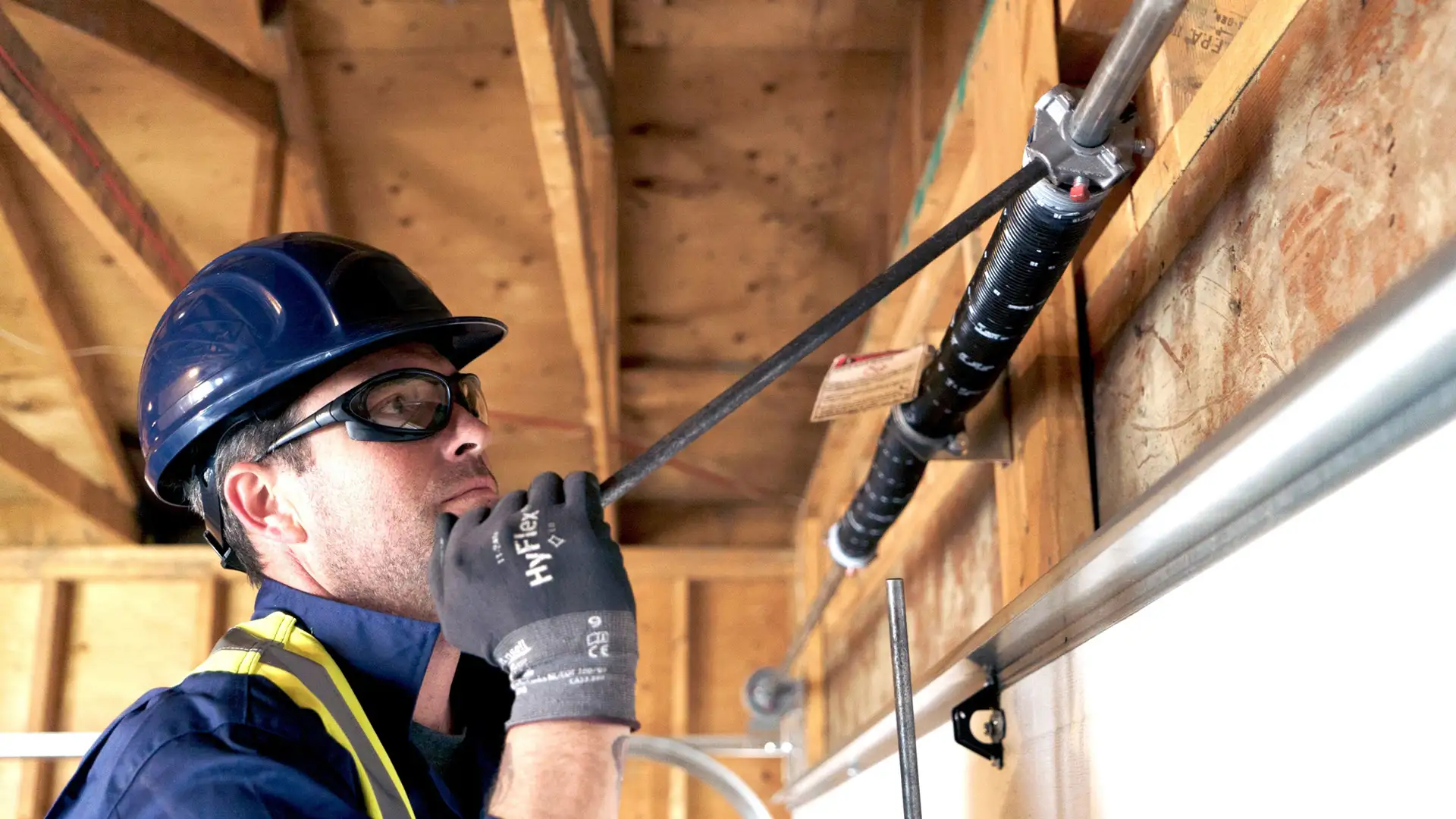
Garage Door Spring Repair & Replacement
A broken spring is the number one reason a garage door stops working. We carry torsion and extension springs for most residential doors and can replace them the same day you call.
A broken spring is the number one reason a garage door stops working. We carry torsion and extension springs for most residential doors and can replace them the same day you call.
Garage door springs have a limited lifespan, typically around 10,000 cycles (one cycle = one open and one close). For a household that uses their garage door 4 times a day, that's roughly 7 years of use before the spring reaches the end of its life.
Cold Canadian winters accelerate wear. Metal contracts in freezing temperatures, making springs more brittle and prone to snapping. When a spring breaks, you'll usually hear a loud bang from the garage.
Never attempt to replace a garage door spring yourself. Springs are under extreme tension and can cause serious injury if handled incorrectly. Always call a trained professional.
Torsion springs are mounted on a metal shaft above the door opening. They use torque to lift the door. Most modern residential doors use one or two torsion springs. They're considered safer and more durable.
Extension springs run along the horizontal tracks on either side of the door. They stretch and contract to lift the door. These are more common on older or lighter doors.
We carry both types in a range of sizes and can match the correct spring for your specific door weight and height. When one spring breaks, we always recommend replacing both to ensure even tension and prevent the second from failing soon after.
A sudden loud noise like a firecracker is the telltale sign of a torsion spring snapping.
The opener strains but the door barely lifts a few inches off the ground.
You can see a clear gap or separation in the torsion spring above the door.
When you disconnect the opener and try to lift manually, the door feels much heavier than it should.
One side lifts faster than the other, meaning one spring has weakened or broken.
Without spring support, the door drops fast when closing instead of lowering smoothly.
Describe the symptoms and we'll send a technician out the same day whenever possible.
We identify your door weight, height, and spring type to select the correct replacement.
We release tension safely, remove the broken spring, and install the new one with proper calibration.
We balance the door, test it manually and with the opener, and verify the safety reversal system.